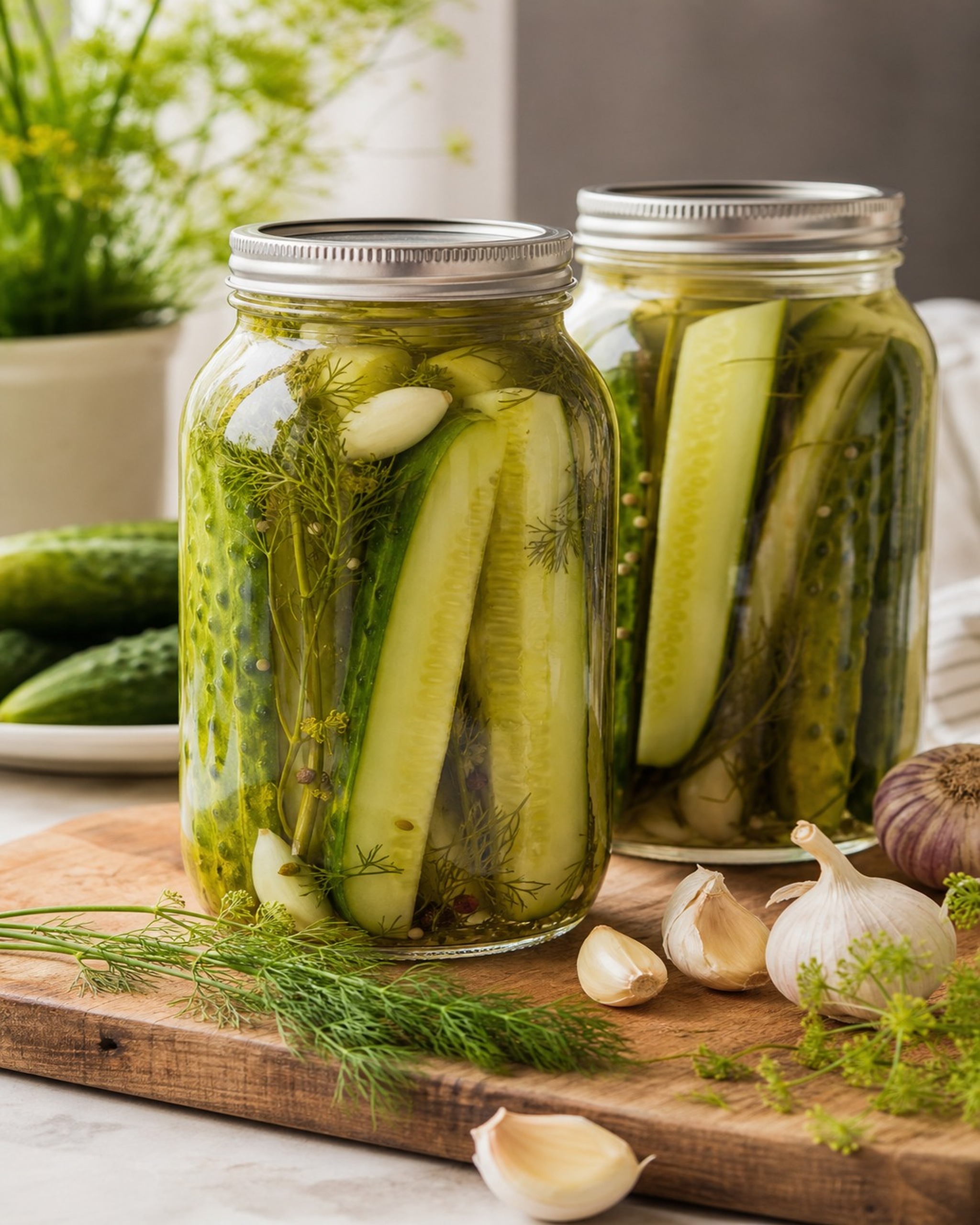
Six pints of deeply garlicky, genuinely crunchy dill pickles from a USDA-tested brine. The one step most beginners skip — trimming the blossom end — is the difference between a snappy pickle and a soft one.
Last updated: July 9, 2026 · By Kitchen Affections Editorial Team
Before you startThe blossom end of a cucumber contains a naturally occurring enzyme called polygalacturonase. If you don't trim it off — a thin 1/16-inch slice — that enzyme stays active during processing and softens the pectin in the cucumber flesh. This is the reason your grandmother's pickles stayed crunchy and yours didn't.
Beyond the trim: use true pickling cucumbers (Kirby or similar), soak them in ice water for at least an hour before packing, use pure pickling salt — never table salt — and don't over-process. Pints need exactly 10 minutes. Every additional minute costs you crunch.
Trim a thin slice (1/16 inch) from the blossom end of every cucumber before packing. This end is opposite the stem. When in doubt, trim both ends. Skipping this step is the most common cause of soft pickles.
Yield: 6 pint jars
Process: 10 min (pints) · 15 min (quarts) · ½ inch headspace
Kirby, National Pickling, or any cucumber labeled "pickling variety." Slicing cucumbers are hollow and make soft pickles. Size matters: 3–4 inches is ideal.
The 1:1 vinegar-to-water ratio is set for safety. Reducing vinegar drops the pH and can create conditions for bacterial growth. Use exactly as written.
Fresh dill heads give a rounder, more complex flavor. Dill seed is fine in off-season but gives a sharper, slightly bitter note. Use dill seed if fresh isn't available.
Cucumbers shrink slightly during processing. Pack them as tightly as you can — standing upright — to minimize floating and maximize yield.
Pints: 0–1,000 ft: 10 min · 1,001–6,000 ft: 15 min · Above 6,000 ft: 20 min
Quarts: 0–1,000 ft: 15 min · 1,001–6,000 ft: 20 min · Above 6,000 ft: 25 min
Source: NCHFP Quick Fresh-Pack Dill Pickles (USDA Complete Guide). More pickle varieties: Ball Blue Book.
Trim the blossom end — a thin 1/16-inch slice. The enzyme at the blossom end causes softening during processing. Beyond that: use small pickling cucumbers, soak in ice water for 1–2 hours before packing, and don't over-process. Pints need exactly 10 minutes.
Technically yes, but the result will be noticeably softer. Pickling cucumbers have thinner skins, fewer seeds, and firmer flesh. If you must use slicing cucumbers, use them young (under 4 inches) and ice-soak for at least 2 hours.
Table salt contains anti-caking agents and sometimes iodine. Both cloud your brine and can discolor the cucumbers. Pickling salt is pure sodium chloride — no additives. It's sold near the canning supplies at most grocery stores.
Slightly cloudy brine from garlic proteins is normal and safe. If you used table salt, that causes cloudiness too — still safe to eat. Discard any jar where the brine is very cloudy, thick, or has an off odor, as this can indicate spoilage.
Wait at least 4–6 weeks before opening. The pickling process needs time for the cucumbers to fully absorb the brine and develop flavor. The best flavor develops around 8–12 weeks.
These are the crunchiest homemade pickles I've ever made. The blossom-end trim is the move — I tell everyone to not skip it. Made four batches this summer and they're all gone.
Better than any store-bought pickle I've ever had. My husband has been requesting these for years. The garlicky brine is perfect — not too sharp, not too mild.
I've tried five different pickle recipes and this is the one. The ice bath step makes a real difference. I added an extra clove of garlic per jar because I like a strong garlic flavor and it was perfect.
Really good. I used dill seed instead of fresh dill heads since it's what I had, and the flavor was still excellent. Took the full 6 weeks to develop, so be patient.